Welcome, Guest
Username Password: Remember me

Profile for WayneReimer

  • OFFLINE
  • Rank: Junior Boarder
  • Register Date: 17 Jul 2012
  • Last Visit Date: 20 May 2013
  • Time Zone: GMT -5:00
  • Local Time: 11:16
  • Posts: 32
  • Profile Views: 216
  • Karma: 8
  • Location: Unknown
  • Gender: Unknown
  • Birthdate: Unknown

Signature

Posts

Posts

emo
I've had one of those for many years...mine was made by Stanley tools, probably 75 years or more ago. (it was my Grandfather's)

They originally were intended for checking bevel on woodworking chisels. Even though every one that I've ever seen has been stamped out of brass, they're accurate. I keep mine in my sharpening box with all my stones from my freehand days
Brass Bevel Gauge
Category: Off Topic
emo
I use a couple of strips of natural chamois to keep knives in place when clamped...works very well. I think the best investment I've made in terms of accessories is a USB microscope for checking edges. It works extremely well for checking a variety of things related to the edge; angle, chipping, uneven grind, verifying whether you're ready to move up with stones, etc.

I also use it off stand for checking stone contamination to avoid unnecessary stone maintenance.At 80-100X you can clearly see metal fragments and clear them more selectively with rare earth magnets. Speaking of which, I have two rod shaped magnets that I slide into a straw. I roll the straw down the length of the stones a couple of times, then hold the straw over the trash can and remove the magnets. the fragments fall into the trash and don't adnere to the magnet, so it's a lot neater. With other shaped magnets, just putthem in a plastic bag first. When you're done, remove them from the bag as toss it;your magnets stay clean that way
Ancillary Equipment
emo
There are actually a few mid-to-high end custom knife makers that use stellite, but Tom Mayo is sort of the
unofficial "King" of stellite. He's used it for well over a decade; not exclusively of course...what I've seen of his work, he tends to reserve 6K for his higher end knives ( bearing in mind that Toms knives have a minimum "price of admission" of around $1000.)

Many makers have avoided it for the same reasons that make it such a durable blade; it's incredibly hard to work with. It eats belts and tooling, so if course that translates into greater aggravation, harder work, increased overhead and higher prices. The last couple of years there seems to be a bit of a surge in interest in it again.

I doubt we'll ever see material like this make it's way into production knives when the cost of a finished 6K blade alone is regularly valued at $300. or more. It is pretty cool stuff though...I'm very grateful that I've been lucky enough to acquire a knife made with it, particularly one made by the good Mr. Mayo
Sharpening Stellite ...
emo
great to know the Android version is out! I knew they were working on it, but hadn't heard it was available yet
Sharpening Stellite ...
emo
I wanted to update this post with a synopsis of how the Stellite 6K has done in a daily carry situation.
I've had the knife in my pocket daily for approximately 2 months now, and after I got over my initial hesitation with using it ( not wanting to put the first scratch on it), I've used it exactly the same way I would use any other daily carry knife...cutting a sandwich, peeling and apple, opening a box or a letter, scoring drywall, cutting tape, etc. etc.

From my initial sharpening two months ago, I have done nothing but strop it every 4-6 days with a one micron strop, followed by a few passes with bare kangaroo. I have been frankly astounded at the level of wear resistance this material has. One of my other EDC knives is 3V steel, the latest "super steel" in terms of wear resistance. The 6K maintains an edge on average 30% longer than the 3V. With 440C, VG10, etc. I'd grown very used to stropping these every day...once a week with the stellite is in reality a bit too much...it really doesn't need it that often.

This material will not handle prying. If you're using your EDC knife for any amount of that sort of thing, this is not the material for you. If you use this stuff stricly for cutting...food, paper, boxes, that sort of thing...it's pretty tough to beat, despite being an "old" material unlike the latest "super steels"

As a matter of interest, for those of you using an iphone, there is a new application available called "Knife Steel Chart" from ZviSoft LLC that is a searchable database of all known steels used in knifemaking. It allows you to search based on material name, the standard,maker, country of origin, or the technology used to produce it.

When you've found the steel your looking for, it gives you a chemical breakdown, it's characteristics, Rockwell rating, alias names, etc.

I've been using it for a couple of weeks, and find it invaluable. Well worth a look
Sharpening Stellite ...
emo
Originally from Calgary Alberta. Since retiring, I have been following my wife around the country with her career, currently in Regina Saskatchewan.

As for Camera equipment, I was a die-hard Fuji fan for many years, and still shoot an S5Pro for weddings and portraiture. I started an independent video production house a couple of years ago and began shooting Sony products for video work, and eventually moved into their mirrorless systems for stills. I currently have a NEX 3, a NEX 5N and a NEX7, and many more lenses than I need, Sony E and A mount and many Nikon lenses as well from my Fuji days. Astonishing that they are able to fit an APS-C sensor and 24 megapixels in a camera as small as this.

I will try to shoot some images of my pens in a few days. I am being admitted to hospital in a couple of hours for surgery so I'll be off-line for a few days
Renaissance in Writi ...
Category: Off Topic
emo
Leo,

I fell in love with fountain pens during my university days, and never fell out of love for them. To be truthful, I am not even sure how many I have at this point...

I'm now retired, but when still employed I think I was viewed by many as a throwback since I would never use a ballpoint unless all other options were exhausted ( I used to keep from 4 to 6 pens, ink, some nibs, etc. in my desk at all times). Even now, years after I have any real need to even carry a pen, I seldom leave the house without one in my pocket.

I own exactly one ball point pen...a Fisher space pen in my maxpedition bag that I haul my camera equipment in.
Renaissance in Writi ...
Category: Off Topic
emo
I think there are too many factors at play here to make anything more than a subjective opinion. I usually carry two knives; one smaller knife, sharpened as sharp as I can make it, stropped nightly and used for light duty cutting (envelopes, fruit etc.)

The second knife is usually either a Strider fixed blade, or one of several Emerson folders. These knives are generally taken to 800 grit, then stropped, and finished with a micro bevel (only a few passes, mind you) of the 800 stones offset 2 degrees from the original bevel, to restore a slight tooth to the edge. It's this knife that gets the "grunt" work...cutting zip-ties, breaking down boxes, general digging, prying, stripping wires, that sort of thing. It will get a light stropping at night, but not anything too extensive. I usually wait until it's showing signs of actual dulling before going back with the stones.

Since I rotate through about 10 knives for this role currently, I seldom carry one "hard use" knife more than a couple of days in succession, so it takes a while (as a general rule, about every third rotation for the knife, or roughly a month)

I sort of prefer the "two knife" approach since I can be pretty confident that regardless of the job I'm tackling, I'll almost always have the right knife, and I will usually have the right knife sharpened properly for the task at hand.

I don't think you can discount the medium you're cutting, the frequency you cut it, nor where you cut it. Although when I'm at work I still carry two knives, the smaller folder gets used much more often for fear of intimidating someone with a larger knife, so at times it "seems" like the smaller, sharper knife dulls more quickly. I think it does also due to the concentration of forces on the edge multiplied by the frequency it's used.

Apples vs. oranges...and then a highly subjective answer results anyway
Fiction or Fact - Do ...
emo
As promised, a shot of the edge of my Mayo TNT with the stellite 6K blade. Sharpened & stropped to 1 micron diamond spray
Sharpening Stellite ...
emo
hi there,
Stellite has been around for quite a few years, and is used in many applications where they need high wear resistance with low/no lubrication. It has only been used by "high end" knife makers primarily due to cost; the raw material for an average 3 inch knife blade runs more than $100....6 or 8 times that of an average high quality blade steel.

Yes I was definitely hitting the edge...I'm an old fan of the sharpie trick. it's simply the nature of stellite; the edge will roll easily due to the cobalt content, and won't tear away due to the chromium and other elemental contents. the only way to eliminate is to abrade it away, and since it's highly abrasion resistant, that too takes some time.

Now that it's very sharp, I'm curious to see how long it will remain that way. There are several scientific papers available, comparing it's wear resistance to a variety of other materials; Talonite, which is also used for knife making, is also known as Stellite 6B...it's less than 50% as wear resistant.

Some others that come to mind;
440C - 6K is approx. 400% more wear resistant
VG-10 - 6K is 70% more resistant
AUS8 - 6K is 80-90% more resistant

know there are several others that were compared, I just can't remember them offhand. Of course, these are lab results, which have little meaning in real world use. I know a number of people with 6K blades, both Mayos and other manufacturers. The consensus seems to be that it is not a steel you'd use for prying or extreme hard use because it doesn't have the sort of Rockwell rating for that application. It's best as a slicing material...I keep wanting to type "Steel", which it isn't....there are several knife makers who specialize in kitchen and chef's knives that use stellite extensively because of it's wear resistance...

I normally carry two knives with me most of the time; lately it has often been a Strider SJ-75s for light duty, slicing things, and a fixed blade Strider SLCC Wharncliffe, or a Strider SA fixed blade for heavier things, prying,etc. I've swapped out the SJ-75s for the Mayo to see how the resilience of the blade material works out

I had a quick look at the edge through the USB microscope just before my wife dragged me out shopping...it looks WONDERFUL for only 1micron stropping. I'll snap a couple of photos later on and post them.
Sharpening Stellite ...
emo
Hi everyone,

I've been absent for a while without good reason other than too many things on the go, including a good deal of knife buying, selling and trading. Much of that culminated with the acquisition of a Tom Mayo medium TNT with a Stellite 6K blade.

For those of you that haven't had the privilege of handling one of Tom's knives...do it if you ever have the chance. Over the years, I have had the chance to handle and use many, many hand made knives. I have never, ever encountered a hand made knife as precise or as beautifully finished as a Mayo. They fetch premium dollars, and I think they're worth every penny.

One thing that Tom is well known for is his use of Stellite 6K for many of his blades. I think it could be argued that he's used more of it for blades in the last 15 years or so than any other knife maker.

Stellite is an interesting alloy. It contains no steel, and is not magnetic. It's made primarily of cobalt and chromium with small percentages of other elements. On a Rockwell scale, it's soft, in the low to mid 40s. It's not terribly sensitive to different heat treat methods, and it's wear resistance is very high regardless of temperature.

I've wanted this knife for years. It's beautiful to look at, it's very functional art, and the stories of the longevity of an edge on 6K are almost legend. I wanted to own one, carry one, and see if everything I'd heard about this alloy were true.

When I received this knife, it had never been sharpened despite it having been through several owners and had been carried. It was still sharp, however it was more a working edge than anything.

I carried the knife for a while before deciding to sharpen it. There's something intimidating about tackling an exotic alloy on a knife that you've invested a lot of money in. There's very little available in the way of info on sharpening it, and contacting Tom Mayo didn't improve that a lot. He sharpens by eye on the grinder, and other than saying the burr could be "troublesome", couldn't add a lot of knowledge to the process for me.

When I mounted the knife, it was sharpened to 24 degrees front and almost 23 degrees on the back. I decided that I would re-profile it to 22 degrees front and back, and set to it with the 100 grit stones.

It's a strange material to work with. initially, there was none of the normal feel or sound of the stones actually doing anything. It took several strokes before the stone started cutting into the edge, and it developed a burr very quickly after that. It was at that point things got "interesting"

Once the burr was formed and the scratches were even along the edge, I switched sides, and the burr rolled to the other side very easily. I ran through 100 strokes and then began to sharpen both sides to eliminate the burr.

Not happening. After 100 strokes of sharpening, I had a really nicely formed, 44 degree inclusive edge, with a nicely formed, very even burr, running full length along the edge. I could not get that thing to break away, regardless of what I tried! Eventually, I just decided to progress through the stones a bit further and see what happened.

I proceeded up through the grits. after one full cycle up to 1000 grit, the burr was shrunken, but still present almost the entire length. I dropped back down to 200 grit and repeated the progression again...same basic result...at 1000 grit the burr had shrunken again, but was still present.

At the end of the afternoon, I have a VERY sharp Mayo TNT 6K. It took three complete progressions through the stones to 1000 grit to eliminate the burr, along with a good deal of "tinkering" at various times and points along the edge to get things balanced and keep them that way. Once sharp, I went on with strops and diamond paste down to 1 micron spray.

A few observations; I am ASTONISHED at how tenacious the burr on this edge was! If that is any indication of how well the edge lasts and wears, I will be VERY happy.

Stellite strops to a beautiful finish. I went for a fairly high shine since this is not a blade that's going to be used for hacking at cable ties or sawing trough boxes. I have knives much better suited than this is.

Overall, it is a frustrating material to sharpen. The end results are great; the relative softness of the cobalt/chromium allows the scratches in the edge to polish out very nicely. I'm hoping I don't have to do the whole thing too often though.
Sharpening Stellite ...
emo
Good tip. The one thing that I might have a concern with since you said it's a gun oil is
whether it has any solvents of any sort in it, and if so how might it interact with the medium holding the stone itself together in the long term.
I would think almost any light oil...perhaps even a light vegatble oil, may have a similar effect. I know we have a bottle of sunflower oil at home...I may give it a try, and tell my wife I made a salad for lunch when she notices the oil in the bottle is depleted :^)
Found an easy way to ...
emo
Just an update on the reprofiled edge and how it's held up. In the past three weeks, I've carried this Emerson roughly 75% of the time as an EDC knife.

In that time, it's been treated to the same sores of things my knives get daily...carboard, zipties, a little mild pruning of some shrubs, scraping a couple of stickers off my garage door, etc.

The edge settled into a "working edge" ( not sharp enough to consistently ribbon phone book paper, but capable if done slowly. Would cut meats, raw and cooked, nicely...vegatables as well, including ripe tomatoes. would not shave arm hair effectively.

Overall, not dull enough to break out the WE, but not as sharp as it had been. Once selttled into that degree of sharpness, it seemed to hold it without significant change for a full week. I was able to restore it back to full sharpness with 50 passes of the 5 micron strop.

This configuration is marginally more difficult to sharpen than the "Emerson Chisel". It's working edge is, however, sharper overall. I have not put it back on the WE for stone work yet,however I will apply stones the next time, likely a few passess with the 1000 grit and then stropping. OVerall, I like it quite well.
Experiments with rep ...
emo
A couple of suggestions to offer since I've done about 100 knives on the Field and Sport so far, including quite a few at 20 degrees. First of all, make sure you actually NEED 20 degrees. There are a lot more edges at 22 than 20 in my experience, including several that are actually published with specs showing 20, when they're actually closer to 22.

There are VERY few knives that won't sharpen at 20 degrees. In my experience so far, that's the cut-off angle; anything below that is dependant on the blade width, but at 20, if you make CERTAIN that you are never trying to sharpen with the bottom bolt extended into the vise too far.

Back out both bolts until they are inside the vise frame. Position your knife properly against the ledge in the top of the vise...VERY important. Then tighten the top bolt onto the knife until the knife is held firmly by the top bolt tension only. DON'T over tighten, but tighten it firmly. you should not be able to move the blade by bumping it. THEN, tighten the bottom bolt in. Again, don't reef on it with both hands; remember the knife is already held in place with the upper bolt.

The blade positioning is important with the F&S, and the bolt issue is big. Another work around based on your photo, try sharpening one side of the blade on the clean side of the vise ( the movable side), then turn the knife in the vise and sharpen the other side.

I hope some of that helps!
Advise needed - Fiel ...
Category: Suggestion Box
emo
you absolutely can strop with bare leather...I do regularly. you won't get the same sort of "gleam" on your edge as you will with a paste or spray, but it depends on what you like and how sharp you want to go. Personally, I don't care all that much about a highly polished edge except on a couple of specific knives.

The majority of my knives get diamond stones to 1000 grit, then stropped with bare kangaroo for a couple of hundred strokes. After I've done that, I do a single pass on the edge with the 1000 grit stone to restore a tiny amount of the tooth ond call it good.

The bare leather gives it a "sheen" as opposed to a "shine" or "polish". It cuts like crazy , it's easy to touch up and is quite durable on most of my knives.

The difference ( in my mind...others with more experience will chime in) with adding a paste or spray is really fine tuning the edge. A polished edge is certainly sharper, but I find it gets to a point where it's almost TOO sharp...there is no grab left. I like a bit of tooth as well, so that I can get a cut started, especially on smooth, hard surfaces like zip-ties. I find those very tough to cut with a polished edge, but much easier to cut with an arguably duller edge with some tooth to grip the surface and start the cut.

Are you confused now? I am...
Paste or no paste or ...
Category: Stropping
emo
Phil, no worries, I understood what you were getting at.I could have been clearer in what I was/am trying to accomplish with this specific edge.

While I have a couple of "testbed" knives that I'm trying to attain the sharpest and most polished edge possible
( a 7in. USMC Ka-Bar and an Emerson Gentleman Jim), with this knife I'm shooting for the most effective "real world" edge I can get.

In terms of defining that goal, since I will likely be carrying the SJ75 frequently, I want to achieve a good, all round cutting edge; one that I can cut a sandwich and peel and apple at lunch, cut through a dozen zip-ties, open mail, break down a shipping package, etc. and do similar tasks for 2 to 4 days without significant degradation in it's cutting ability.

I know I can attain a much sharper edge on this knife, I also know it will be much more fragile, leading to daily maintenance which I may not have time ( or inclination for that matter) to perform.

With both the Emerson and the Ka-Bar, I've been able to achieve tremendously sharp, polished edges. Although I've got 50 years of freehand sharpening under my belt, and am pretty darn good at it, I've never had sharper knives than these two are currently. Could they be even sharper? Almost certainly, but I doubt it with the stones and strops I currently have. As it is now, they both make me somewhat uneasy, especially the Ka-Bar, because they're so sharp.

But, as I said...these are "experiments". the Ka-bar dulls quite quickly. It's certainly still sharp, but it loses that "laser-like" quality easily. The Emerson holds onto the edge longer, but it's still not something I'd rely on as a sole EDC blade; the edge is fragile and I'm quite sure it would chip or roll over with vigorous use. It's all a juggling act, me thinks!
I tried something di ...
emo
[
Hey Wayne, I read in a thread on Bladeforums a while back that J. Ankerson and some other guys actually get some of the best cutting performance and edge retention as well by sharpening just like you describe.

Putting that toothy micro-bevel on a polished back bevel was supposedly a very good way to sharpen your edc for maximum performance and retention during both slicing and push cutting.

I think you stumbled on to a good thing.[/quote]

Isn't that interesting! Maybe I did...? I used the knife off and on all day, and I'm very pleased with the way it's performing so far. Things like this are one of the reasons I am really enjoying the WE. It lets you experiment with things a lot more without the time investment that free hand sharpening would demand.

It's also such a noticeable improvement over other "systems" and various sharpening "enhancements". I got this particular knife from another knife lover. He told me he'd sharpened it with a crock stick and was really pleased with the edge it had, and how well it had lasted.

It was sharp when I got it. 15 minutes later, it was SO much sharper, and I hadn't even stropped the blade at that point.

The SJ75 is such a fantastic little EDC knife, I'd really like to find the optimal progression for this edge. It's a small knife that cuts awfully big right out of the bag...being able to really fine tune the edge will really make it a "wicked" little everyday knife
I tried something di ...
emo
Most of the knives in my collection fall into the more "tactical" styling, and I pocket carry at least one per day. I use all of my knives regularly, and none too gently, so my needs for an edge are dictated by overall usability, sharpness, and durability. Appearance ( i.e. polish) is a secondary concern.

I have a number of Striders of various sizes depending on the job I may need to do. Lately, I've been carrying a mini SJ75 a lot. This is a bit of a polarizing design; some love it, some hate it (looks wise), but the ergonomics are superb, and it's a tremendous little knife. The problem is that it's a knife that, to me anyway, screams for a polished edge, so of course you lose a bit of cutting ability with a good polish. I should mention that my standard for a good polish is different than many of you; for me a good polish stops at 1000 grit, with stropping to 1 micron followed by bare kangaroo leather.

Yesterday, I re-profiled this knife from 22 degrees per side to 20, and took it to my "polished" standard. It was extremely sharp, however I'd lost the tooth that I like to have for things like zip-ties, etc.

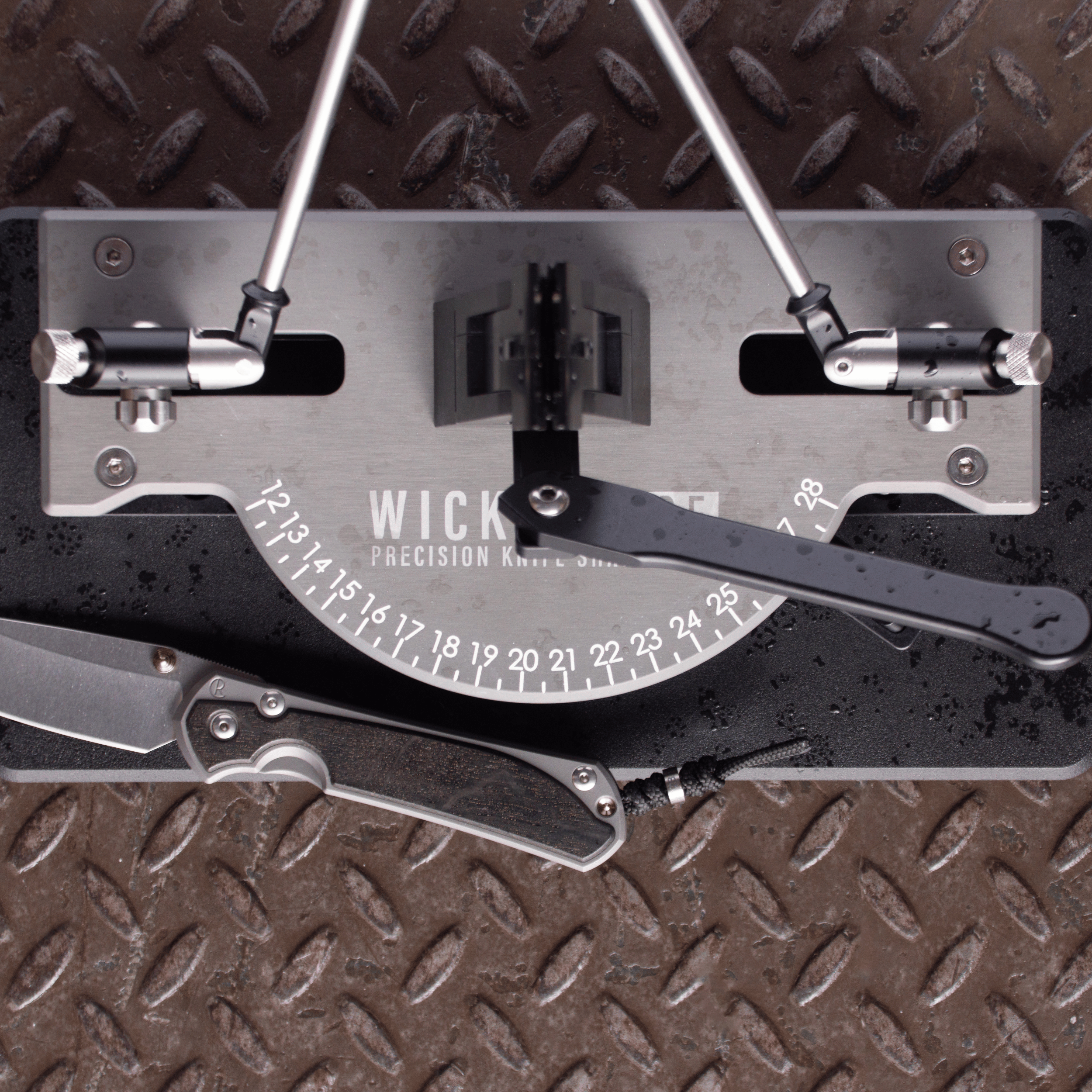
In an attempt to solve this, I re-mounted the knife ( I use a Field and Sport, BTW), set the arms at 22 degrees ( remember the knife is now at 20 degrees) and did one pass, tip to heel with a 1000 grit stone.

There is no visible difference, naked eye. With a ten power loupe I can see it pass, but barely. Cutting performance however is improved. I have some tooth back and cutting zip-ties ( which I seem to be doing a lot of lately) is noticeably easier.

My question is this; what other ideas do you have for having a polished edge that still has some tooth? I've tried stopping at a lover grit stone and stropping from there, but the toothiness is muted by the stropping. It seems to me that re-introducing some fresh tooth after the strop like this gives a bit more "bite" to the cut, but I'm sure curious about others experiences
I tried something di ...
emo
Although I have a bunch of Emerson knives, I've never been a fan of chisel grinds. While they have certain advantages, they also have disadvantages that for me have always been an irritation. Even their "V" grinds are not true "V' grinds in the conventional sense, having more in common with chisel grinds than the conventional "V" grinds others used.

After getting quite comfortable with the WE Field and sport, having sharpened over 100 knives now, I thought I would experiment a bit, and try some things on an Emerson.

The one I chose for a testbed is an Emerson Gentleman Jim. It's a "V" grind blade, with a micro bevel of around 30 degrees on the front, and about 15 on the back. Effectively not much different than their chisel grind, just sharpened as a micro bevel.

I've been sharpening this knife as I would a full chisel grind; 30 degrees on the front, and once I've reached 1000 grit, I knock the burr off the back side with a 1000 grit stone at around 15-16 degrees, then strop.

It gives a great, very sharp and very durable edge, but it still cuts like a chisel which is not what I prefer. So...today was the day.
First, do I re-profile it as a symmetrical or asymmetrical edge? Again, advantages and disadvantages to both. I chose asymmetrical.

To avoid completely revising the front, I decided to stay at 30 degrees. I wanted a solid, sharp and most importantly durable edge. I figured setting the back to 18 degrees might be an expedient solution, and perhaps a workable one too, with a 48 degree inclusive edge.

I ran through the stones from 100 grit to 1000 grit, with 100 passes per side. At 1000 grit, I added an extra 50 strokes per side...for good luck?? I guess that's as good a reason as any.

I then started to strop; 100 strokes per side 5 micron, 3.5 micron, 1 micron diamond spray, then plain leather.

I was left with a very nicely polished edge, but taking it off the WE, my "finger test" said "this isn't very sharp..."

This is a clear demonstration that the long relied on "fingertip test" is not worth much. I always keep last years phone book for testing edges, as I'm sure many of you do. I cut out a couple of pages, fully expecting the knife would not cut well at all.

How wrong could I be? Turns out I was about as wrong as possible. This edge is FAR sharper than it has ever been. Effortless hair shaving, cutting 1/8 in. ribbons of phone book paper, sliicing paper thin slices from a ripe tomato...straight slices, not the angled ones that you get with a chisel edge.

I have a bunch of short lengths of rope and paracord, so I started push cutting paracord. I ent through about 3 feet of it, then tried the tomato again. the same thin slices from it were no problem.

I think this edge is going to be quite durable, and it looks great. I'll keep everyone posted on how it stands up
Experiments with rep ...
emo
Since I have quite a few Emersons, your question was one I asked of Clay when I first received my Field & Sport. I went with his suggestion, and have been very pleased with the results.

I do all the work on the bevel, up to 1000 grit at 30 degrees, 50 passes per grit. After finishing with the bevel at 1000, I set the back angle as shallow as I can depending on the knife ( a Gentleman Jim is quite ai bit narrower than a CQC 7, 8, 14, etc.) and make a couple of very light passes to knock off the burr.

By the time you've finished the bevel to 1000 grit, the burr is quite pronounced, and you can see it pop free in most instances.

I then strop with leather strops, 5 micron, 3.5 micron and finish with 1 micron spray. When I hit the 1 micron point, I normally do 50 passes bevel only, then finish the sharpening with another 50 passes, alternating between the bevel and the back.

This gives me a polished edge...not a super high gloss, perfect mirror finish, but certainly one you can see a reflection in. It's proven to be quite durable; I use my EDC knives constantly throughout a normal day, and I find I'm doing a touch up with the 1 micron strops every 2-3 days.

One of my Emersons, a CQC 14, is particularily hard use; two weeks ago it substituted for an oyster knife and shucked two dozen oysters. That pretty much destroyed the finish and dulled the knife beyond even a marginal working edge.

It didn't chip, however, and it restored perfectly with the above progression. I would like a bit more toothiness on that knife, so the next sharpening I will got to 1000 grit, but only strop with the 5 micron strops. I think that may give me the perfect combo for this knife; really sharp with enough tooth to bite into whatever surface I'm cutting
Emerson folders
More
Time to create page: 1.97 seconds