Welcome, Guest
Username Password: Remember me

Advanced Search

Search Results

Searched for: Straight razor video
09 Jan 2013 19:15

JustinLanham

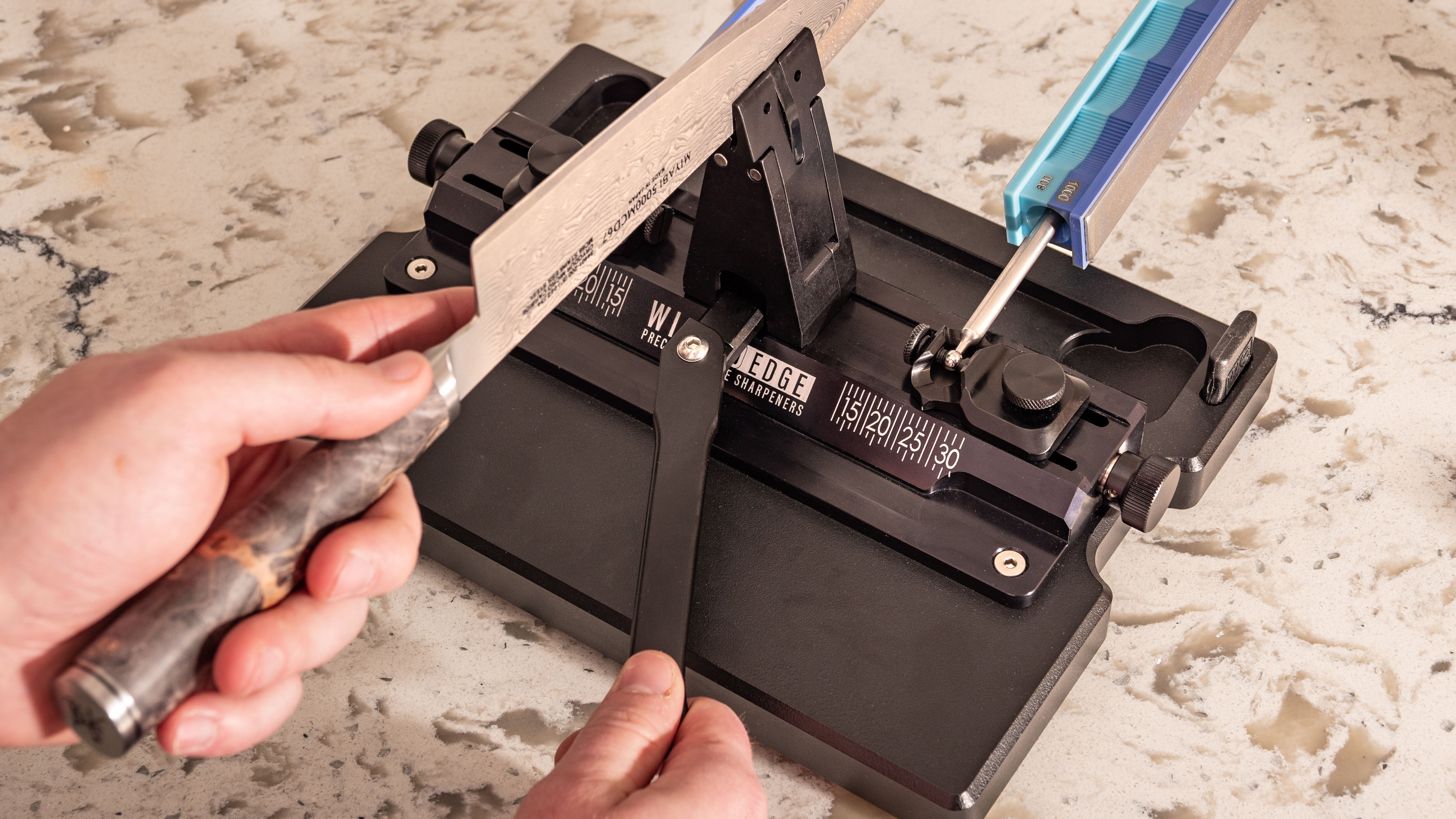
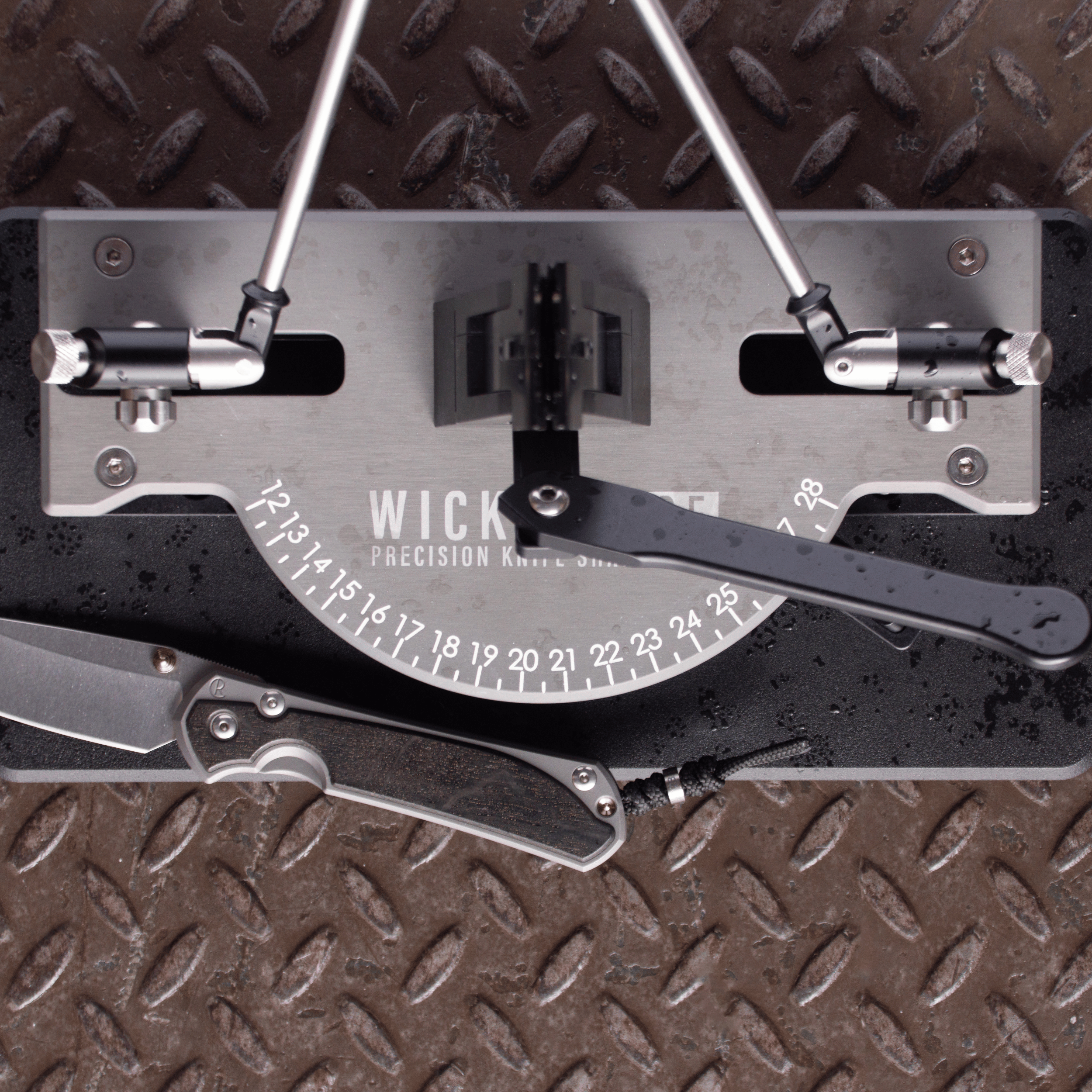
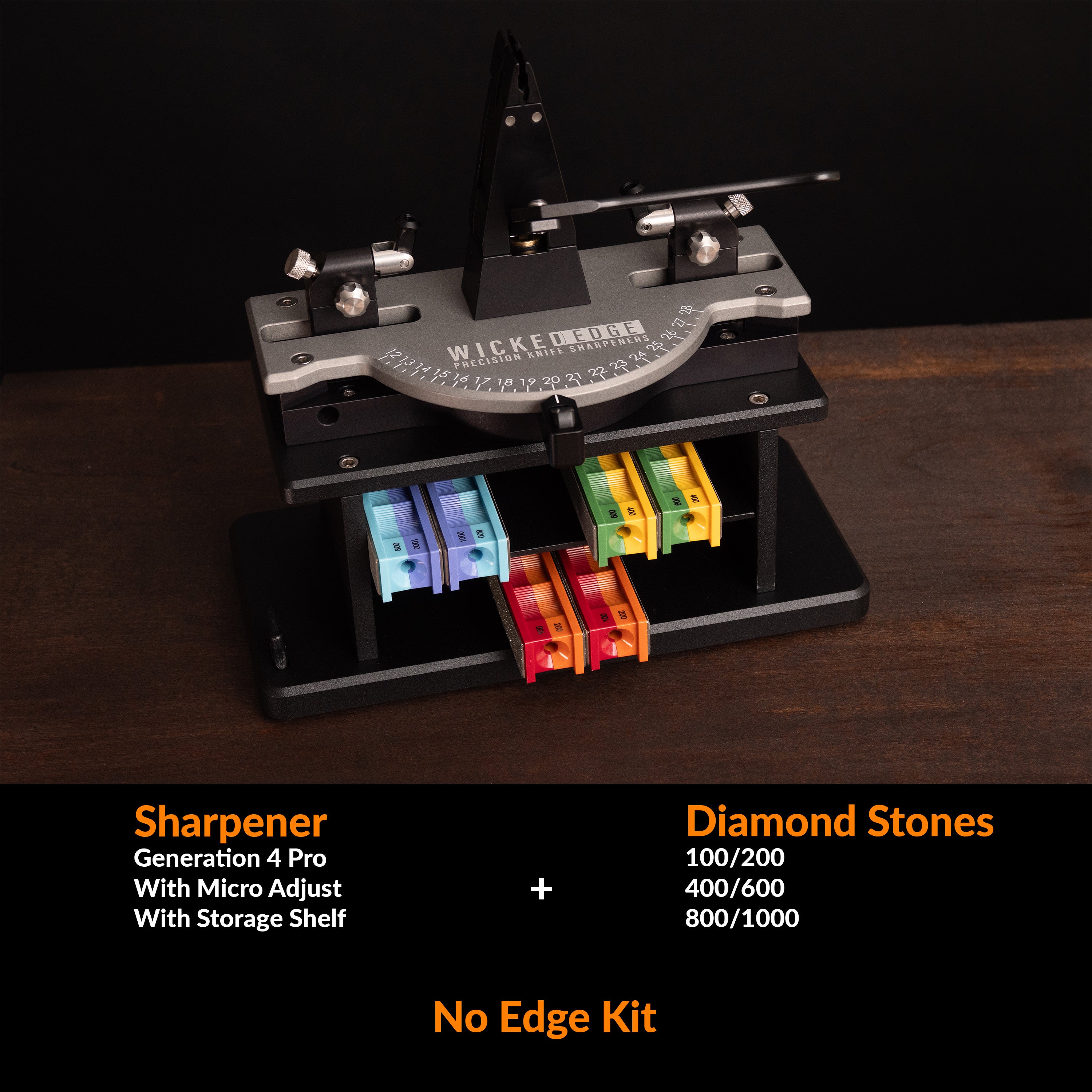
Hi all. I just upgraded to a Wicked Edge, read all the instructions, watched a bunch of videos, read a bunch of threads, practiced on some kitchen knives, then moved on to my folders. The problem I am having is that I cannot get the curve near the tip of my knives sharp. The straight part of the blade will remove hair without touching skin, but the curved part will not shave at all, and will barely cut paper cleanly. I have tried several knives of different lengths and shapes, as well as different angles, but I keep getting the same results. Razor sharp until you get to the tip!

Sorry for the newb question, but does anyone have any suggestions? Thanks in advance!
11 Dec 2012 17:32

Mikedoh

Clay produced a video where he held the razor by the tang only. Then rotated the rod holders 90*. Not sure this works with the upgraded arms.
There's a video here if you scroll down a bit.

www.wickededgeusa.com/index.php?option=c...rums=1&Itemid=63
Category: Shaving
24 Sep 2012 17:22

PhillipHyun

Hi Clay,

Any progress on the straight blade video? I am very curious as I have a sheeps foot style blade that has a perfectly straight edge (Kevin Wilkins Parforce). I've been wondering how to sharpen this on the WEPS. Could you clarify what the "two Points" you were referring to on earlier responses on this thread? 2 points along the edge and the spine?

Thanks!
19 Sep 2012 12:46

wickededge

razoredgeknives wrote:
yeah, the new ball joint arms probably fix this... I was just having issues w/ the older joint. it is hard to explain w/out pics/video. I will try to do one or the other for you at some point soon (when i'm not so busy) so everyone can batter see what happens on the old ones.

clay, are the new ball joints limited in the range of motion at all when you rotate them forward? or is it not enough to cause any issues when you are doing straight razors? (i.e. clamping on the base of the spine).


Good question Josh. I'll try to bring a razor in this week and shoot a little video. I'm by no means an expert on straight razors, far from it, but I think you'll the way it works. On the other hand, the mod you've done already is awesome, don't know why you'd need anything different.
18 Sep 2012 18:32

razoredgeknives

yeah, the new ball joint arms probably fix this... I was just having issues w/ the older joint. it is hard to explain w/out pics/video. I will try to do one or the other for you at some point soon (when i'm not so busy) so everyone can batter see what happens on the old ones.

clay, are the new ball joints limited in the range of motion at all when you rotate them forward? or is it not enough to cause any issues when you are doing straight razors? (i.e. clamping on the base of the spine).
18 Sep 2012 09:25

razoredgeknives

The method in the video doesn't work... At least in my experience. The reason is because when you flip the base of the arms forward your angle constantly changes on your edge through your stroke. I have also found the stock pastes /strops to not work for me (although Clay and others have excellent results on knives). I have found the cheapest *fix as far as progression goes to be going up to your ceramics and then on to lapping films and finishing on a strop ( 125 cbn works great).
18 Sep 2012 06:12

cbwx34

davidmcm77 wrote:
Now I don't think he is going to be shaving with this as it is being used as a prop for a video trailer for a book of hers.

So... why do you need to sharpen it??? Seriously, if it's going to be a prop, they may not want it sharp, since it may not be handled properly... maybe just make it look sharp by polishing the sides? This could be done by just using the strops.

Anyway...

17 Sep 2012 22:55

ApexGS

David,

Clay has a very informative video on his youtube channel demonstrating a good method of handling straight razors on the Wicked Edge. I haven't gotten to try that yet and don't have any razors handy myself, but many folks here can attest to even a relatively short progression giving extremely good results. Of course the pursuit of perfection drives some of the folks around here to the far end of the spectrum with the finest polish possible, but don't be too skittish of the earlier progressions and grits! I would venture that a half micron polish on a fine angle is well beyond shaving sharp
17 Sep 2012 21:07

davidmcm77

Hello all,
I was just given an old straight razor by a friend of mine that he asked me to sharpen for him
Now I don't think he is going to be shaving with this as it is being used as a prop for a video trailer for a book of hers.
So my big question is am I capable of getting this razor shaving sharp with the WEPS? Right now I have the pro pack plus a set of 1k-2k Shaptons, and the ceramics. I slap have strops down to .5 micron.
Will I be able to produce an edge capable shaving facial hair with this set up? And is it going to be best for me to clamp the razor or use the spine of the razor as a guide and do it freehand?

Thanks,
David
06 Sep 2012 07:32

jendeindustries

I won't get too caught up in the Verhoeven or the True Hone - The Verhoeven is a great starting point. His first few pages are spot on with my experiences with sharpening, but I see some flaws and lacking to the experiments, especially the water stone section. On the other hand, he probably gets the best True Hone edges in the world!!


Part of what makes an edge cut better is reducing this jaggedness... which is why honing a coarse edge will make it cut better. You can actually make a coarse edge cut better by making a 90 deg. pass over a fine stone (Harrelson Stanley from Shapton talked about this in a sharpening session I attended, and mentions it in one of his videos). Of course the tradeoff is you make the edge thicker, so a coarse edge cut across an 8K stone wouldn't be as sharp as an edge sharpened to an 8K finish.


Right - and this is a very good example of "polishing the grooves" IMO.

The perception is that a finer edge "dulls quicker"... but the argument could also be made that it merely "dulls down to the level of the refined coarse edge"... and will then dull at the same rate. In other words, an edge that is shaving sharp will, to the user, dull faster than an edge that would never shave to begin with, because the perception is less obvious


Agreed. Even amongst straight razor shavers, there is a debate about edge retention being longer on lower grits (8K-10K) than on higher grits, despite the shaves being much closer and longer lasting off the higher grits. This is where the "pencil point" theory enters the game - in which every edge of the edge, no matter what the geometry, will ultimately approach the point of 0 width, and just like a freshly sharpened pencil, the fresh point/edge is ohh-so good, but quickly degrades to a "work sharp" that lasts considerably longer than the fresh edge.

Also, while you mentioned convex edges more in passing... most are "stronger" simply because they're sharpened at a much higher angle than a flat bevel. Obviously, a thinner profile is weaker than a thicker one, but it's not as related to the finish level that you describe?


This is a very interesting aspect that I've been having thoughts about for some time now and would have now to agree with you and now the Verhoeven about reduced jaggedness. Geometry helps to influence the ease of cutting, with more acute geometry cutting with greater ease than more obtuse geometry, and refinement doesn't necessarily play as major a role in most cases. I believe that technique trumps refinement 90% of the time. But the technique in being able to get that is another issue Since I've been involved in sharpening, it's almost always been the case with less advanced sharpeners that refinement fills the lack of technique gap.

It is obvious that an 8K edge will shave or cut better than a 1K edge... no doubt about that. Maybe, (and perhaps BassLakeDan's testing machine will show... especially if it could be combined with some actual measurements of the edge) there is higher level of sharpness achieved across a smaller width of edge? In other words, maybe it's possible that a .5m edge cuts 50x better than a .8m edge? (Just throwing numbers in as an example). So, while there's not necessarily as great a change as you describe... even the smaller change results in a more obvious result? This combined with reducing the jaggedness of the coarser grit, is why it will cut better. Just food for thought.


I think thinner width edges will cut better because of less surface area/resistance to sever into and cut the material/fibers, but that increases the amount of force put on a smaller area the edge, which could help to explain why thinner edges seem to degrade faster.

The next area to look into is what is the "optimal" thickness of a given edge for a given task. For example, food prep doesn't require the thinnest edges (ask any wife!), and many butchers actually prefer a very coarse/toothy saw-like edge to rip the meat rather than slice.

Great Stuff, CBW!
Category: Abrasives
03 Sep 2012 08:57

cbwx34

jendeindustries wrote:
Here's where we begin to search deeper into the rabbit hole

Before I define "Robustness", it would be better to answer about the smoothness of an edge and its impact on durability.

As with all things sharpening, it depends. Smoothness is only one of several factors that will determine the outcome to whether or not a smoother edge lasts longer. Geometry plays one of the largest roles, as well as the steel characteristics.

That's all I can say for now - I will be back in a few hours to further answer!


OK - I'm back

Smoothness has two roles. The first, is when one sharpens for perfection. When removing all previous scratches at each level, the edge of the edge will ultimately become thinner and thinner while the "teeth" from the scratches become smaller and smaller (or less deep). This makes the edge feel smooth, as in approaching a shave-ready edge. Let's call this a "true X grit edge". For example, when sharpening for perfection up to 8K, this would be a "true 8K edge" because most/all of the scratches are 8K or 2 micron in size. That would also determine the the thinness/thickness of the edge of the edge at a given angle.

However, as the edge of the edge becomes thinner as the tip approaches the theoretical 0 width at the apex of the triangle, the steel and geometry characteristics kick in. Softer steel will roll with more ease, as will more acute geometry, giving the perception that the edge has been lost. While the edge of the edge of a "true higher grit" edge will be more fragile due to its thinness, rolling may not necessarily ruin the edge. Straight razors, for example, are easily refreshed/straightened out with a few ultra light passes on a strop. The trick with more refinement is to reinforce the geometry with microbevels and/or convexing to get them to be more sturdy. Then you run into the problem of having your edge geometry too obtuse for the task, which leads us to role #2.

The second role of smoothness is literally "polishing the grooves", and would be the definition of a "more robust" edge in my mind. In this manner of sharpening, the idea is that the edge is shaped with coarser grits, and then those coarse grit scratches are then polished with the paste, slurry or mud - which is a mixture of loosened abrasive, binder and metal, but without the intention of establishing a "true" higher grit edge. For example, at 1K, the edge of the edge is theoretically ~16 microns thick. This is too thick for comfortable face shaving, which needs an 8K or ~2 microns thick edge to cut hairs without pulling. The 1K edge is a decent working edge because it is thick enough to withstand more of a beating without rolling (+ proper geometry and steel). If you polish the grooves of a 1K edge, you can push cut, and shave arm hair, but under the scope, you still have a very toothy 1K-ish edge. We have seen this with the 1K WEPS edge followed by the 1K WEPS diamond PASTE.

So if you're still with me... Here's how we can put some of it together in a VERY general statement.

WEPS Diamonds are "true" grit.
Shapton Pro stones are "true" grit.
Chosera stones create ~90% "true grit with about ~10% polishing of the grooves.
Naniwa Super Stones are about 90% polishing the grooves and 10% true grit.

With understanding the general "philosophies" of the stones, you can now begin to pick and choose series/stones based on what you intend to do and how you want you finished edge.

So a more robust edge could be a 1K edge stropped with some 0.5 micron paste or spray.
A better slicing edge would be step by step or small leaps up to 5K or more.
And everything in between!


Hey Tom...

I'm puzzled by some of what you say. I've seen you mention before that the thickness of the edge is based on the stone grit. If you look at some of Clay's recent microscope pics... and also the pictures in Verhoeven's study... www.bushcraftuk.com/downloads/pdf/knifeshexps.pdf ... this doesn't seem to be the case. For example, an edge sharpened on a 1000g Truhone wheel is 1m thick (p. 9), while you seem to indicate it has to be 16m thick. There are other examples throughout the paper. I do agree that a thinner edge is possible at finer grits (which the paper also supports), but maybe not to the level you describe? The edge doesn't have to be as thick as the stone rating... it does "cut thru to the other side" (which I think is your reason that it should be this way)... but the result of this is why the edge is more jagged at higher grits... not necessarily thicker (at least not the thickness of the actual grit level). More of a "side view" vs. a "straight down view" way of looking.

Part of what makes an edge cut better is reducing this jaggedness... which is why honing a coarse edge will make it cut better. You can actually make a coarse edge cut better by making a 90 deg. pass over a fine stone (Harrelson Stanley from Shapton talked about this in a sharpening session I attended, and mentions it in one of his videos). Of course the tradeoff is you make the edge thicker, so a coarse edge cut across an 8K stone wouldn't be as sharp as an edge sharpened to an 8K finish.

The other part that I wonder about, is that a fine edge is weaker, and has to be "reinforced" or made "more sturdy". The perception is that a finer edge "dulls quicker"... but the argument could also be made that it merely "dulls down to the level of the refined coarse edge"... and will then dull at the same rate. In other words, an edge that is shaving sharp will, to the user, dull faster than an edge that would never shave to begin with, because the perception is less obvious. Also, while you mentioned convex edges more in passing... most are "stronger" simply because they're sharpened at a much higher angle than a flat bevel. Obviously, a thinner profile is weaker than a thicker one, but it's not as related to the finish level that you describe? Also, a finer edge will be more influenced by any burr or wire edge that remains, that wouldn't be as noticed on a coarse edge. To put it another way... yes an 8K edge at 20 deg. may last longer than at 15 deg., but so will a 1K edge. (Both will cut better at 15 deg. though). This also helps answer the question of what angle to sharpen at.

It is obvious that an 8K edge will shave or cut better than a 1K edge... no doubt about that. Maybe, (and perhaps BassLakeDan's testing machine will show... especially if it could be combined with some actual measurements of the edge) there is higher level of sharpness achieved across a smaller width of edge? In other words, maybe it's possible that a .5m edge cuts 50x better than a .8m edge? (Just throwing numbers in as an example). So, while there's not necessarily as great a change as you describe... even the smaller change results in a more obvious result? This combined with reducing the jaggedness of the coarser grit, is why it will cut better. Just food for thought.
Category: Abrasives
11 Jul 2012 18:24

razoredgeknives

Ken, I'll probably order some... if its fine w/ clay can you post your prices? or would you rather a phone call...

Dan, I REALLY appreciate your video series on the aluminum blanks/3m lapping film. I did the same thing you did w/ the al blanks and then got some PSA 3m lapping film (silica carbide i think) and have obtained outstanding results...the smoothest, closest shave on my straight razor to date (and i have all sorts of strops/compounds, etc). Thanks for the video and recommendation. Oh, and I can verify that you MUST lap the aluminum blanks, they are not completely flat from Lowes or HOme depot.
Category: Suggestion Box
16 Jun 2012 20:04

KenSchwartz

Here's a second video he did demonstrating a new technique using a lght moistening spray. Not sure if this helps or not, but it certainly looks promising. I'm impressed with how it also gets out some of those residual deep scratches in addition to refining the finish.


---
Ken
31 May 2012 06:32

mark76

Waiting axiously for my nanocloth and roo paddles . I do not have a video camera, but I will definitely post the results here!
30 May 2012 17:48

leomitch

Thanks for getting back to me Ken! I now have a clearer idea of how to use the nano-cloth, I think...you use compound/spray on it as one might on a leather strop or balsa. Forgive my ignorance...I am going to get more deeply into this soon; I am getting way behind in what appears to be some important sharpening advances...the video slapped me upside the face so to speak. I will PM you shortly Ken.

Leo
Displaying 1 - 15 out of 17 results.
  • Page:
  • 1
  • 2
Time to create page: 1.80 seconds